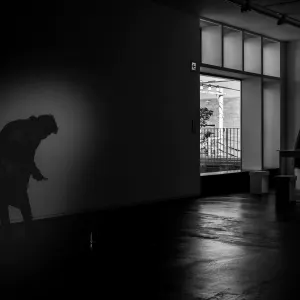
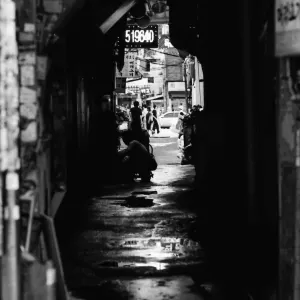
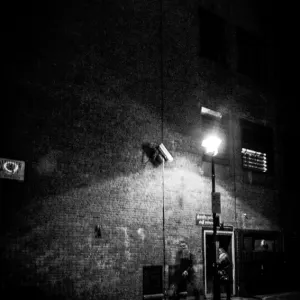
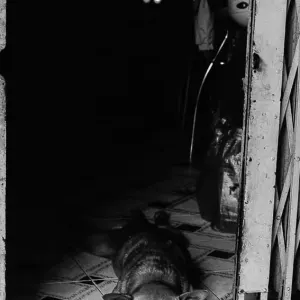
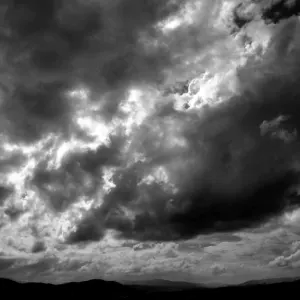
This photo of my photoalbum was taken in Okinawa.
A film scanner is a device made for scanning photographic film directly into a computer without the use of any intermediate printmaking. They provide several benefits over using a flatbed scanner to scan in a print of any size — the photographer has direct control over cropping and aspect ratio from the original unmolested image on film, and many film scanners come with specialized software or hardware designed to remove scratches, film grain, and improve color reproduction from old negatives. Film scanners can accept either strips of 35 mm or 120 film, or individual slides. Low-end scanners typically only take 35mm film strips, while medium- and high-end film scanners often have interchangeable film loaders. This allows the one scanning platform to be used for different sizes and packaging. For example, some allow microscope slides to be loaded for scanning, while mechanised slide loaders allow many individual slides to be batch scanned unattended.
Technical Pan was a panchromatic black and white film produced by Kodak with unique characteristics that have not been replicated. It was generally used as a very slow film, rated at ASA 25 or even 16, although it could be rated at up to ASA 320. This film was grainless to an exceptional degree, especially when rated at a low speed, and made excellent enlargements while preserving fine details. Kodak stopped selling it in 2004. It has not been replaced by a film (from any manufacturer) with its exceptional characteristics. The detail in a 35mm negative is far superior to any digital consumer camera in 2007. The film could be developed at home, mainly by using the chemical mixture Technodol, which Kodak sold for that purpose alone. To achieve exact results, home development was often the preferred process. Like other panchromatic films, it cannot be developed under a red safe light. When the film was discontinued, Kodak revealed that none had been made for many years, and that it was still on the market only due to a large roll being found in frozen storage. The film was created for the military and was no longer required for that purpose. Consequently, Kodak cut the roll into commercially viable formats and continued to sell it. Unexposed Technical Pan is now quite valuable and very difficult to find. Tech Pan, as it is often known, was very popular among some professional photographers and astronomers, as it was capable of recording extremely fine detail, and its sensitivity curve extended much further into the red than that of most films. In particular, it was very senstitive to light emitted by hydrogen at 656.3nm, which made it very useful for a wide range of astronomical imaging. Tech Pan was also useful for electron and laser photography. The film was popular with photographers in the art and fashion industries for its extremely high-contrast results when up-rated and processed in an abrasive, high-strength developer.