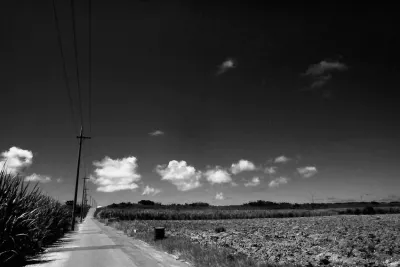
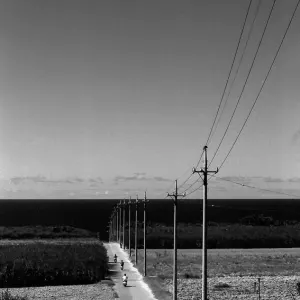
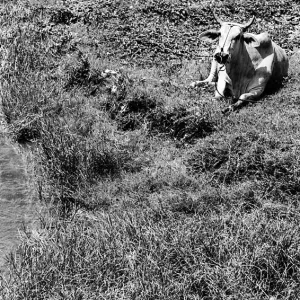
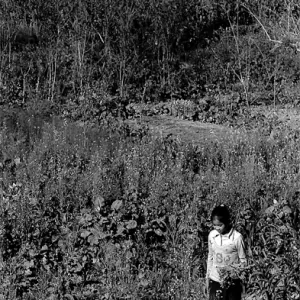
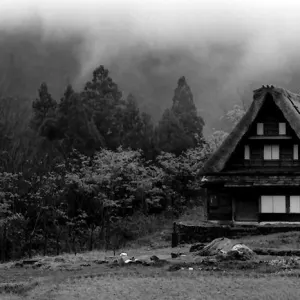
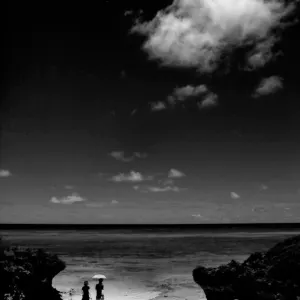
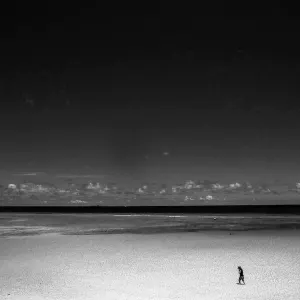
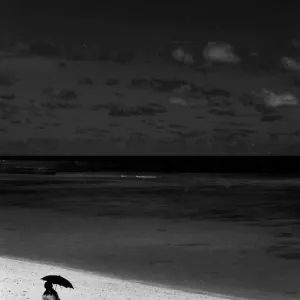
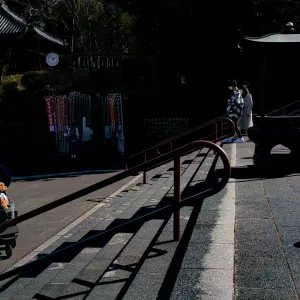
This photo of my photoalbum was taken in Okinawa.
The Asahiflex was a 35mm single-lens reflex camera built by the Asahi Optical Corporation (later to become Pentax). It was the first SLR camera built in Japan. Asahi Optical introduced its first 35 mm camera in 1952. Unlike the majority of Japanese camera manufacturers of the time, Asahi made a conscious decision not to produce a mere German rangefinder copy, a relatively simple task. Asahi's designers (Nobuyuki Yoshida and Ryohei Suzuki) were convinced of the inherent superiority of the SLR and so proceeded along these lines. This effort resulted in the Asahiflex I, which was also the first Japanese 35mm SLR. The Asahiflex I had a non-interchangeable waist-level viewfinder, with a direct optical viewfinder for eye-level use. The Asahiflex I had a non-returning mirror (which, however, was directly coupled to the shutter button, so only when the shutter button was released the mirror returned to the down position) and shutter speeds from 1/25 to 1/500. The camera used the M37 screw mount. The Asahiflex went through some minor modifications for flash use, resulting in the IA. With the IIB a key advance was made - the quick-return mirror. The problem of mirror black-out was one of the main problems with prior SLR designs, greatly reducing usability and leading to the greater popularity of the rangefinder. With the IIB there emerged the first practical quick-return mirror, a vital innovation and one which was quickly adopted by other manufacturers. With the final model in the series, the IIA, the Asahiflex gained slow speeds from 1/25th of a second to 1/2 of a second.
The company began in December, 1949 in Nagano, Japan, when the Yashima Seiki Company was founded with an initial investment of $566. Its eight employees originally manufactured components for electric clocks. Later, they began making camera components, and by June 1953 had introduced their first complete camera, the Yashimaflex, a twin-lens reflex (TLR) medium-format camera designed for 6x6cm rollfilm. The Yashimaflex and successive cameras used lenses sourced from the Tomioka Optical Works, beginning a relationship that would last for years. Also in 1953, the company’s name was changed to Yashima Optical Industry Company, Ltd. In 1957, Yashima founded Yashica, Inc., a subsidiary arm in New York City to manage marketing efforts in the USA. 1957 also marked the introduction of a popular new TLR camera series, the Yashica Mat line. During the next year and a half, Yashima continued to grow, with 1,982 employees by 1958. Later in 1958, Yashima changed its name to Yashica Company, Ltd, when it acquired the Nicca Camera Company, Ltd. The Nicca acquisition was fortuitous, greatly expanding the company’s market into 35mm film cameras. The Yashica Pentamatic, an advanced, modern 35mm Single Lens Reflex (SLR) camera with a proprietary bayonet-mount and interchangeable lenses, was introduced in 1959. As before, Yashica continued to source its lenses from the Tomioka Optical factory. Around 1960-61, Yashica made yet another important acquisition, the Zunow Optical Industry Co. Ltd. Though a small company, Zunow had become well-known for its limited production of a very advanced SLR camera, along with several high-quality, fast lens designs. In December 1965, Yashica introduced the world’s first electronically controlled 35mm camera, the Electro 35, a popular rangefinder model that eventually sold 5 million units. The company continued to expand its international markets, and in August 1968, Yashica finally acquired its lens manufacturer, the Tomioka Optical and Machine Manufacturing Co., Ltd. (later re-named the Tomioka Optical Co. Ltd.). By this time, Tomioka was one of the largest and most reputable lens manufacturers in Japan. Sales of 35mm SLRs continued to grow steadily, and Yashica was quickly acquiring a reputation for both electronic camera expertise and high-quality optics. 1968 also marked the year of Yashica's last major TLR camera design, the Yashica Mat-124, a popular model which combined some of the best features of Yashica's earlier TLR cameras. In 1973, Yashica the company began a collaboration with Carl Zeiss to produce a new, professional 35mm SLR with an electronically-controlled shutter, bearing the Contax brand name. A new prestige line of Yashica / Contax lenses designed by Carl Zeiss were introduced for the camera, with a common C/Y bayonet mount allowing lens interchange between all 35mm Contax and Yashica SLR camera models. The F. Alexander Porsche Group was hired to complete an ergonomic and styling study of the new camera. The new Contax RTS appeared at Photokina in 1974, and proved a success. Yashica soon introduced several new 35mm SLR cameras beginning with the FX-1 (1975) and FX-2 (1976). Also in that year, Yashica developed the upscale Yashica FR. The FR was capable of using the entire range of Carl Zeiss T* lenses. This practice of ‘pairing’ similar Contax models with more affordable, less full-featured, but still high-quality Yashica models would continue for the next 10 years. The FR was quickly followed in April 1977 by the FR-I and FR-II. In 1979, Yashica introduced a new inexpensive 35mm consumer SLR, the FX-3, intended for entry-level buyers. Like all Yashica manual-focus bodies, the affordable FX-3 would also accept Carl Zeiss T* lenses. This simple, lightweight manual-exposure SLR camera sold well, and stayed in production until 2002. In October 1983, Yashica Company Ltd. was acquired by ceramics giant Kyocera. Initially, the merger resulted in few outward changes. The manual-focus (MF) FX-103 Program, introduced in 1985, continued the ‘pairing’ tradition of high-end Yashica SLR models with Contax (Contax 159mm), and was the first Yashica SLR with TTL flash and full programmed exposure capabilities. After 1983, all Yashica cameras were made by Kyocera (Kyoto Ceramics), which also made newer Contax cameras. In 2005, Kyocera halted production on all Contax, Yashica, and other Kyocera branded film and digital cameras.