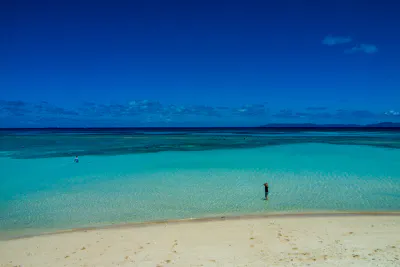
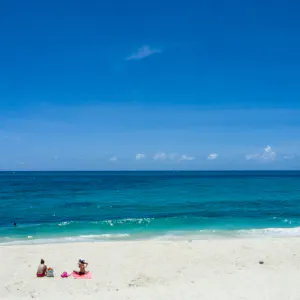
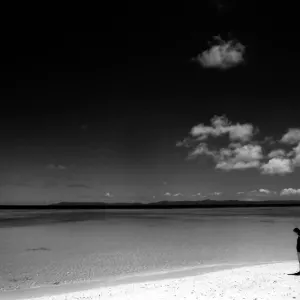
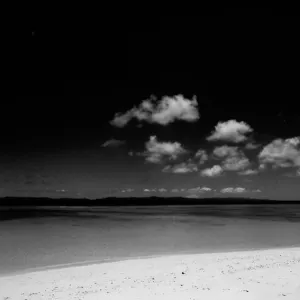
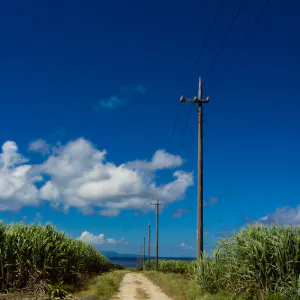
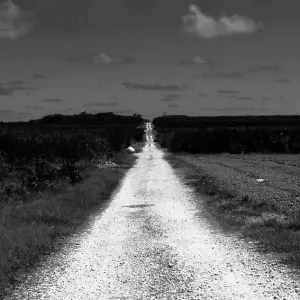
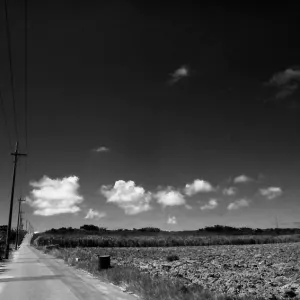
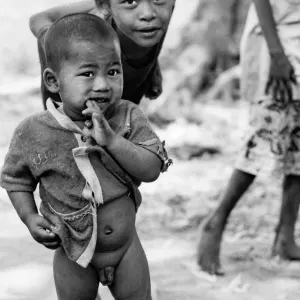
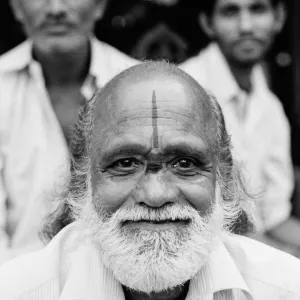
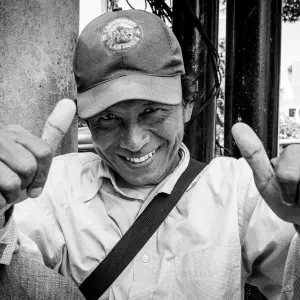
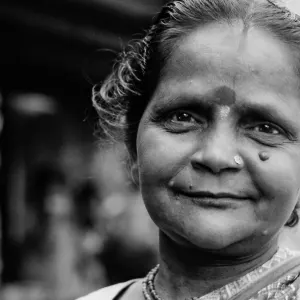
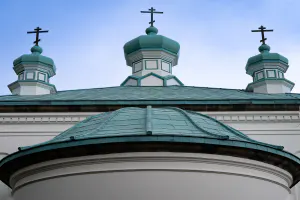
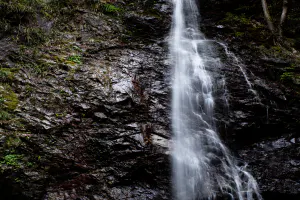
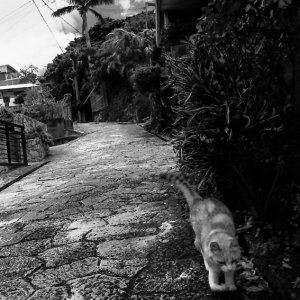
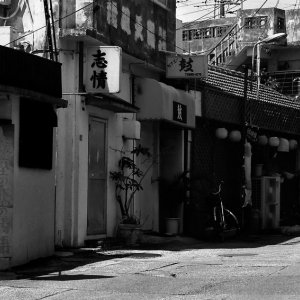
This photo of my photoalbum was taken in Okinawa.
Saipan is the largest island and capital of the United States Commonwealth of the Northern Mariana Islands (CNMI), a chain of 15 tropical islands belonging to the Marianas archipelago in the western Pacific Ocean (15°10’51”N, 145°45’21”E) with a total area of 115.39 km² (44.55 sq mi). The 2000 census population was 62,392. Located at latitude of 15.25° north and longitude of 145.75° east, about 200 km (120 mi) north of Guam, Saipan is about 20 km (12.5 mi) long and 9 km (5.5 mi) wide. It is a popular tourist destination in the Pacific. The western side of the island is lined with sandy beaches and an offshore coral reef which creates a large lagoon. The eastern shore is composed primarily of rugged rocky cliffs and a reef. Its highest point is a limestone covered mountain called Mount Tapochau at 474 m (1,554 ft). Many people consider Mount Tapochau to be an extinct volcano, but is in fact a limestone formation. To the north of Mount Tapochau towards Banzai Cliff is a ridge of hills. Mount Achugao, situated about 2 miles North, has been interpreted to be a remnant of a stratified composite volcanic cone whose Eocene center was not far north of the present peak. Besides English, the indigenous Chamorro language is spoken by approximately 19 percent of the inhabitants.[citation needed] The current governor of the CNMI is Benigno Fitial, who is the successor of Juan Babauta.
Traditional Chamorro culture is visually manifested in dance, sea navigation, unique cuisine, games (such as batu, chonka, estuleks, and bayogu), songs and fashion influenced by the migration of peoples from other lands. Spanish policy during colonial rule (1668-1898) was one of conquest and conversion to Roman Catholicism. This led to the gradual elimination of Guam's male warriors and displacement of the Chamorro people from their lands. In spite of the social upheavals, Guam's matriarchs—known as "I Maga'håga"—continued the indigenous culture, language, and traditions. Historian Lawrence Cunningham in 1992 wrote, "In a Chamorro sense, the land and its produce belong to everyone. Inafa'maolek, or interdependence, is the key, or central value, in Chamorro culture ... Inafa'maolek depends on a spirit of cooperation. This is the armature, or core, that everything in Chamorro culture revolves around. It is a powerful concern for mutuality rather than individualism and private property rights." The core culture or Pengngan Chamorro is comprised of complex social protocol centered upon respect: From the kissing of the hands of the elders (inspired by the kissing of a Roman Catholic bishop's ring by those whom he oversees), passing of legends, chants, and courtship rituals, to a person requesting forgiveness from spiritual ancestors when entering a jungle. Other practices predating Spanish conquest include galaide' canoe-making, making of the belembaotuyan (a string musical instrument), fashioning of åcho' atupat slings and slingstones, tool manufacture, Måtan Guma' burial rituals and preparation of herbal medicines by Suruhanu. Master craftsmen and women specialize in weavings, including plaited work (niyok- and åkgak-leaf baskets, mats, bags, hats, and food containments), loom-woven material (kalachucha-hibiscus and banana fiber skirts, belts and burial shrouds), and body ornamentation (bead and shell necklaces, bracelets, earrings, belts and combs made from tortoise shells). Today only few masters exist to continue these traditional art forms.
Early Palauans may have come from Australia, Polynesia and Asia. Depending on the thread of the family, Palauans may indeed represent many parts of Melanesia, Micronesia and Polynesia. However, it is traditionally considered to be Micronesian. According to geneticists, there are two distinctive strains of Melanesian bloodlines: one is associated with indigenous Australians/Papua New Guineans and the other is known to have originated in Asia. There has not been any link established between the two. Until recently, Palau was not considered a part of Micronesia. In the European and Australian world Belau/Pelew is better known by the name of "The Black Islands". Vintage maps and village drawings can be found at the Australian library online, as well as photos of the tattooed and pierced Ibedul of Koror and Ludee. Carbon dating and recent archaeological discoveries have brought new attention to the archipelago. Cemeteries uncovered in islands have shown Palau has the oldest burial ceremony known to Oceania. Prior to this there has been much dispute as to whether Palau was established during 2500 BC or 1000 BC. New studies seem to dispute both of these findings. Moreover, Palau's ancient trading partner, Java, has also come under close scrutiny since Homo floresiensis was found. Interestingly, Java is where traditional female Palaun money originated. Carrying on the family line, Palauan women have always been embellished with land, titles and money. For thousands of years, Palauans have had a well established matrilineal society.