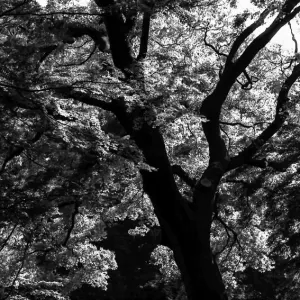
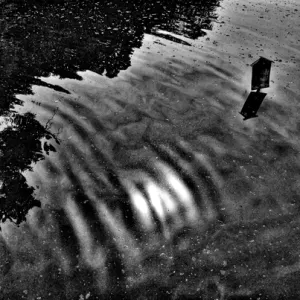
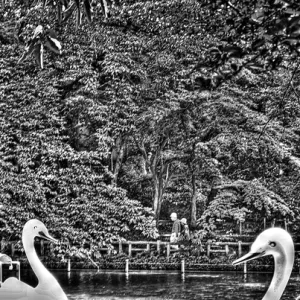
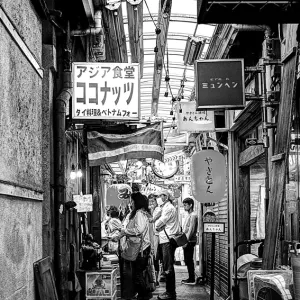
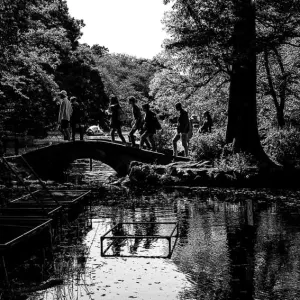
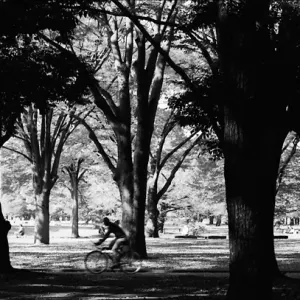
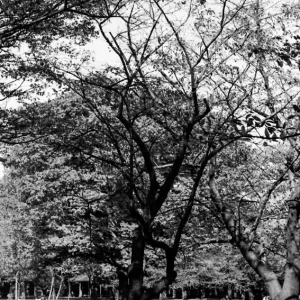
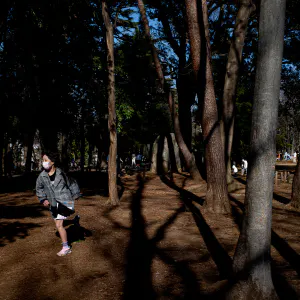
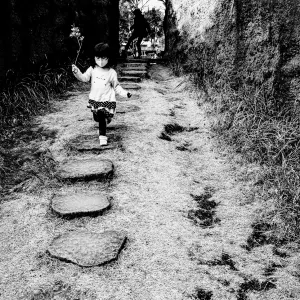
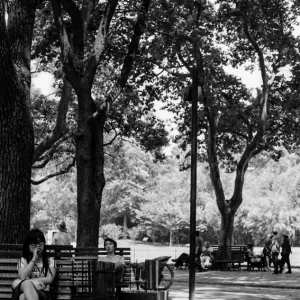
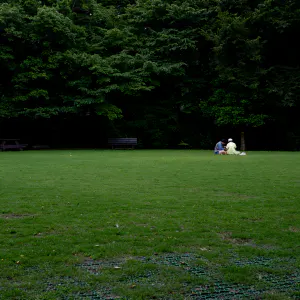
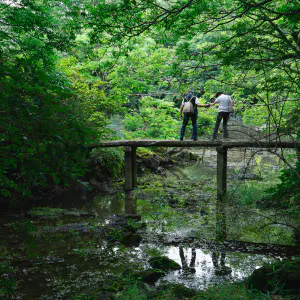
This photo of my photoalbum was taken in Inokashira park of Tokyo.
His first works, such as Tintern Abbey (1795) and Venice: S. Giorgio Maggiore (1819), stayed true to the traditions of English landscape. However, in Hannibal Crossing the Alps (1812), an emphasis on the destructive power of nature had already come into play. His distinctive style of painting, in which he used watercolor technique with oil paints, created lightness, fluency, and ephemeral atmospheric effects. (Piper 321) One popular story about Turner, though it likely has little basis in reality, states that he even had himself "tied to the mast of a ship in order to experience the drama" of the elements during a storm at sea. In his later years he used oils ever more transparently, and turned to an evocation of almost pure light by use of shimmering colour. A prime example of his mature style can be seen in Rain, Steam and Speed - The Great Western Railway, where the objects are barely recognizable. The intensity of hue and interest in evanescent light not only placed Turner's work in the vanguard of English painting, but later exerted an influence upon art in France, as well; the Impressionists, particularly Claude Monet, carefully studied his techniques. In the modern art era, advocates of abstract art were also inspired by Turner. It has been suggested that the high levels of ash in the atmosphere during the 1816 "Year Without a Summer," which led to unusually spectacular sunsets during this period, were an inspiration for some of Turner's work. John Ruskin says in his "Notes" on Turner in March 1878, that an early patron, Dr Thomas Monro, the Principal Physician of Bedlam, was a significant influence on Turner's style: His true master was Dr Monro; to the practical teaching of that first patron and the wise simplicity of method of watercolour study, in which he was disciplined by him and companioned by Giston, the healthy and constant development of the greater power is primarily to be attributed; the greatness of the power itself, it is impossible to over-estimate.
Turner's talent was recognized early in his life. He became a full art academician at the age of 29.[citation needed] Financial independence allowed Turner to innovate freely; his mature work is characterized by a chromatic palette and broadly applied atmospheric washes of paint. According to David Piper's The Illustrated History of Art, his later pictures were called "fantastic puzzles." However, Turner was still recognized as an artistic genius: the influential English art critic John Ruskin described Turner as the artist who could most "stirringly and truthfully measure the moods of Nature." (Piper 321) Suitable vehicles for Turner's imagination were to be found in the subjects of shipwrecks, fires (such as the burning of Parliament in 1834, an event which Turner rushed to witness first-hand, and which he transcribed in a series of watercolor sketches), natural catastrophes, and natural phenomena such as sunlight, storm, rain, and fog.He was fascinated by the violent power of the sea, as seen in Dawn after the Wreck (1840) and The Slave Ship (1840). Turner placed human beings in many of his paintings to indicate his affection for humanity on the one hand (note the frequent scenes of people drinking and merry-making or working in the foreground), but its vulnerability and vulgarity amidst the 'sublime' nature of the world on the other hand. 'Sublime' here means awe-inspiring, savage grandeur, a natural world unmastered by man, evidence of the power of God - a theme that artists and poets were exploring in the late 18c. and early 19c. The significance of light was to Turner the emanation of God's spirit and this was why he refined the subject matter of his later paintings by leaving out solid objects and detail, concentrating on the play of light on water, the radiance of skies and fires. Although these late paintings appear to be 'impressionistic' and therefore a forerunner of the French school, Turner was striving for expression of spirituality in the world, rather than responding primarily to optical phenomena. ("The Sun is God," he stated shortly before his death.)
Eugène Henri Paul Gauguin (7 June 1848 – 9 May 1903) was a leading Post-Impressionist artist. Best known as a painter, his bold experimentation with colouring led directly to the Synthetist style of modern art while his expression of the inherent meaning of the subjects in his paintings, under the influence of the cloisonnist style, paved the way to Primitivism and the return to the pastoral. He was also an influential exponent of wood engraving and woodcuts as art forms.
Nikkor is the brand of lenses produced by Nikon Corporation, including camera lenses for the Nikon F-mount. The Nikkor brand was introduced by Nippon Kogaku K.K. (Nikon's original corporate name) in 1937. Nikon originally reserved the Nikkor designation for its highest-quality imaging optics, but in recent history almost all Nikon lenses are so branded.
The Nikon F2 is a professional level, interchangeable lens, 35 mm film, single-lens reflex (SLR) camera. It was manufactured by the Japanese optics company Nippon Kogaku K. K. (Nikon Corporation since 1988) in Japan from 1971 to 1980. It used a horizontal-travel focal plane shutter with titanium shutter curtains and a speed range of 1 to 1/2000th second plus Bulb and up to 10 seconds using the self timer, flash X-sync of 1/80th second. It had dimensions (with DE-1 head, see below) of 98 mm height, 152.5 mm width, 65 mm depth and 730 g weight. It was available in two colors: black with chrome trim and all black. The F2 is the second member of the long line of Nikon F-series professional level 35 mm SLRs that began with the Nikon F (manufactured 1959 - 1974) and followed each other in a sort of dynastic succession as the top-of-the-line Nikon camera. The other members were F3 (1980 - 2001), F4 (1988 - 1996), F5 (1996 - 2005) and the present day F6 (2004 - present). The F-series do not share any major components - unless the continuous use of the redoubtable hardened stainless steel Nikon F bayonet lens mounting flange is considered as a common part. Instead, Nippon Kogaku designed each generation from the ground up to be its contender as the best camera in the world. By and large, they were successful in that mission. All Nikon professional F-series SLRs are full system cameras. This means that each camera body serves as only a modular hub for a huge variety of accessories that extend its capabilities to perform whatever picture taking task that a photographer might ask for.