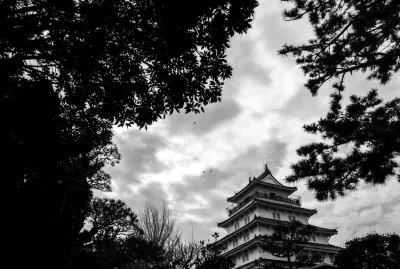
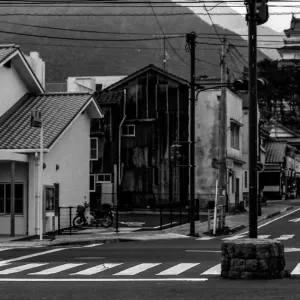
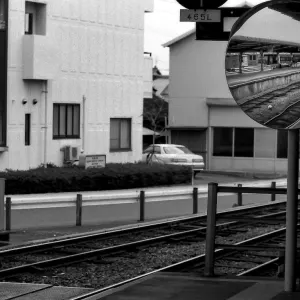
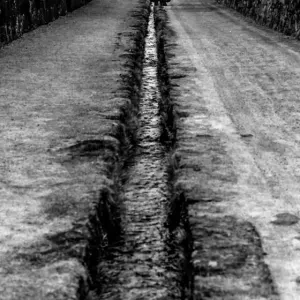
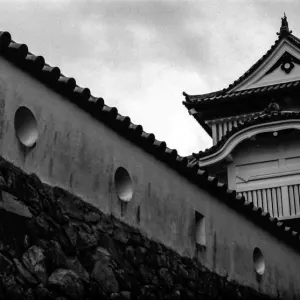
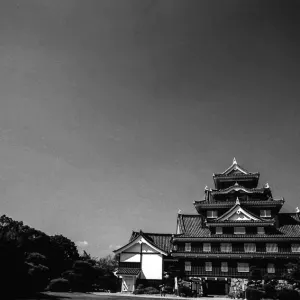
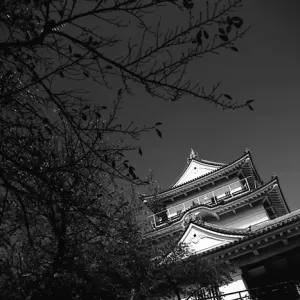
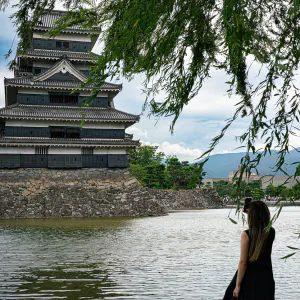
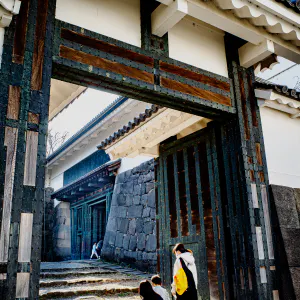
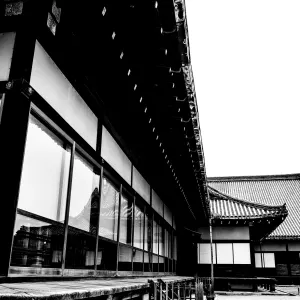
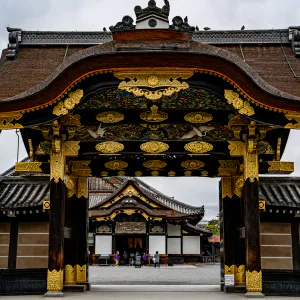
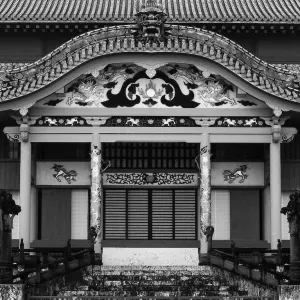
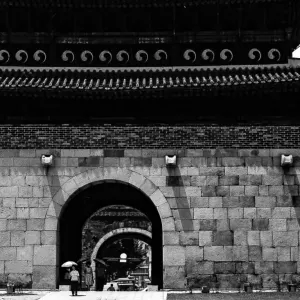
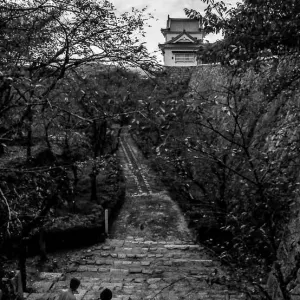
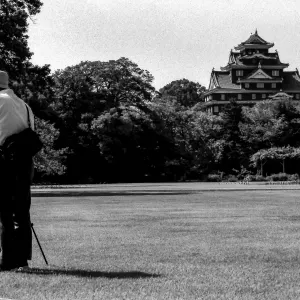
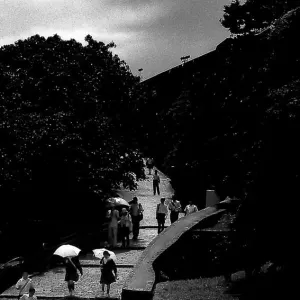
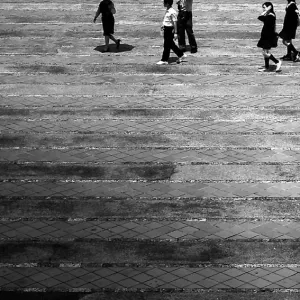
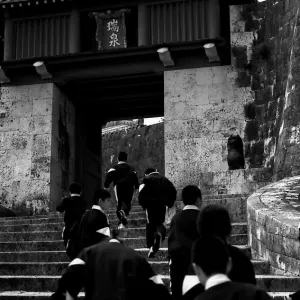
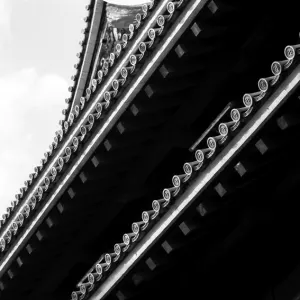
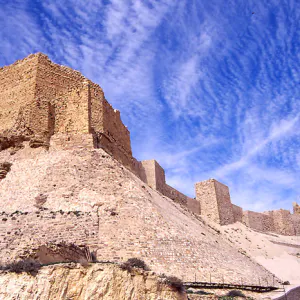
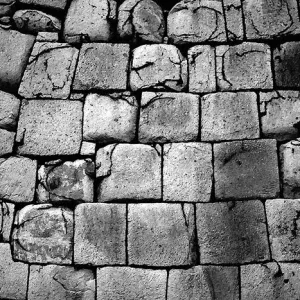
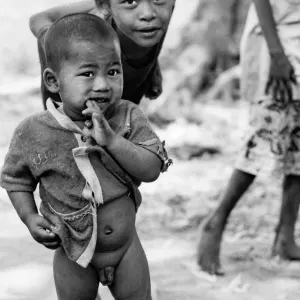
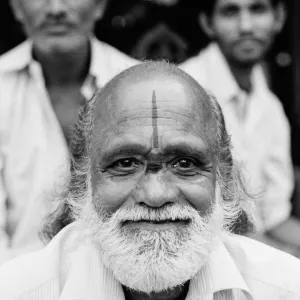
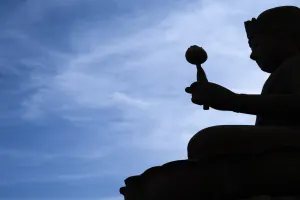
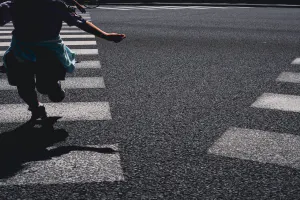
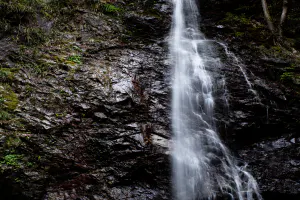
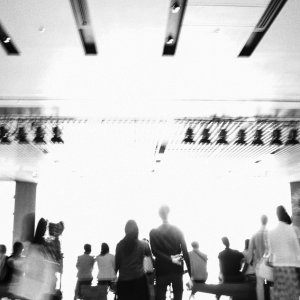
This photo of my photoalbum was taken in Shimabara Castle.
In photography, shutter speed is the time for which the shutter is held open during the taking of a photograph to allow light to reach the film or image sensor (in a digital camera). In combination with variation of the lens aperture, the shutter speed regulates how much light the camera will record. For a given exposure, a fast shutter speed demands a larger aperture to avoid under-exposure, just as a slow shutter speed is offset by a very small aperture to avoid over-exposure. Long shutter speeds are often used in low light conditions, such as at night. Shutter speed is measured in seconds. A typical shutter speed for photographs taken in sunlight is 1/125th of a second. In addition to its effect on exposure, shutter speed changes the way movement appears in the picture. Very short shutter speeds are used to freeze fast-moving subjects, for example at sporting events. Very long shutter speeds are used to intentionally blur a moving subject for artistic effect. In early days of photography, available shutter speeds were somewhat ad hoc. Following the adoption of a standardized way of representing aperture so that each major step exactly doubled or halved the amount of light entering the camera (f/2.8, f/4, f/5.6, f/8, f/11, f/16, etc.), a standardized 2:1 scale was adopted for shutter speed so that opening one aperture stop and reducing the shutter speed by one step resulted in the identical exposure. The agreed standard for shutter speeds is:
In geometrical optics, a focus, also called an image point, is the point where light rays originating from a point on the object converge. Although the focus is conceptually a point, physically the focus has a spatial extent, called the blur circle. This non-ideal focusing may be caused by aberrations of the imaging optics. In the absence of significant aberrations, the smallest possible blur circle is the Airy disc, which is caused by diffraction from the optical system's aperture. Aberrations tend to get worse as the aperture diameter increases, while the Airy circle is smallest for large apertures. An image, or image point or region, is said to be in focus if light from object points is converged about as well as possible in the image; conversely, it is out of focus if light is not well converged. The border between these conditions is sometimes defined via a circle of confusion criterion.
In optics, an aperture is a hole or an opening through which light is admitted. More specifically, the aperture of an optical system is the opening that determines the cone angle of a bundle of rays that come to a focus in the image plane. An optical system typically has many openings, or structures that limit the ray bundles (ray bundles are also known as pencils of light). These structures may be the edge of a lens or mirror, or a ring or other fixture that holds an optical element in place, or may be a special element such as a diaphragm placed in the optical path deliberately to limit the light admitted by the system. In general, these structures are called stops, and the aperture stop is the stop that determines the ray cone angle, or equivalently the brightness, at an image point. In some contexts, especially in photography and astronomy, aperture refers to the diameter of the aperture stop rather than the physical stop or the opening itself. For example, in a telescope the aperture stop is typically the edges of the objective lens or mirror (or of the mount that holds it). One then speaks of a telescope as having, for example, a 100 centimeter aperture. Note that the aperture stop is not necessarily the smallest stop in the system. Magnification and demagnification by lenses and other elements can cause a relatively large stop to be the aperture stop for the system. Sometimes stops and diaphragms are called apertures, even when they are not the aperture stop of the system. The word aperture is also used in other contexts to indicate a system which blocks off light outside a certain region. In astronomy for example, a photometric aperture around a star usually corresponds to a circular window around the image of a star within which the light intensity is summed.
A camera is a device used to capture images, as still photographs or as sequences of moving images (movies or videos). The term as well as the modern-day camera evolved from the camera obscura, Latin for "dark chamber", an early mechanism for projecting images, in which an entire room functioned as a real-time imaging system. The camera obscura was first invented by the Muslim scientiest Alhazen and desribed in his Book of Optics (1015-1021). English scientists Robert Boyle and Robert Hooke later invented a portable camera obscura in 1665-1666. Cameras may work with the light of the visible spectrum or with other portions of the electromagnetic spectrum. A camera generally consists of some kind of enclosed hollow, with an opening or aperture at one end for light to enter, and a recording or viewing surface for capturing the light at the other end. Most cameras have a lens positioned in front of the camera's opening to gather the incoming light and to focus the image, or part of the image, on the recording surface. The diameter of the aperture is often controlled by a diaphragm mechanism, but some cameras have a fixed-size aperture.
Mount Everest or Qomolangma or Sagarmatha or Chomolungma pronounced as (Jongmalunga) is the highest mountain on Earth, as measured by the height of its summit above sea level. The mountain, which is part of the Himalaya range in High Asia, is located on the border between Nepal and China. As of the end of the 2006 climbing season, there have been 3,050 ascents to the summit, by 2,062 individuals, and 203 people died on the mountain. The conditions on the mountain are so difficult that most of the corpses have been left where they fell; some of them are easily visible from the standard climbing routes. Climbers are a significant source of tourist revenue for Nepal; they range from experienced mountaineers to relative novices who count on their paid guides to get them to the top. The Nepalese government also requires a permit from all prospective climbers; this carries a heavy fee, often more than $25,000 per person.
Sherman works in series, typically photographing herself in a range of costumes. For example, in her landmark 69 photograph series, the Complete Untitled Film Stills, (1977-1980) Sherman appeared as B-movie, foreign film and film noir style actresses. Sherman's most recent series, dated 2003, features her as clowns. Although Sherman does not consider her work feminist, many of her photo-series, like the 1981 "Centerfolds," call attention to the stereotyping of women in films, television and magazines. In response to cuts to NEA funding and attempts to censor photographers Robert Mapplethorpe and Andres Serrano, in 1989 Sherman produced the Sex series. These photographs featured pieced-together medical dummies in flagrante delicto. Like much of Sherman's work, many critics find the series both disturbing and funny. Many art critics consider Sherman to be not only the most successful female photographer of the modern era, but one of the most successful artists of either genders in the late twentieth century with as much influence on younger artists as did Andy Warhol in his era.