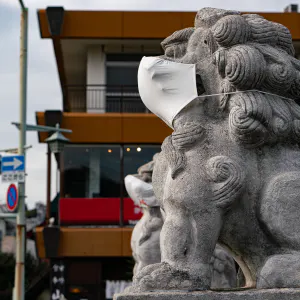
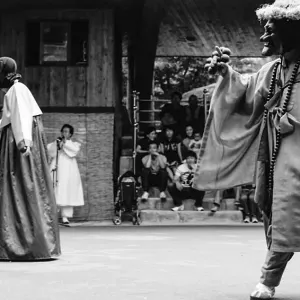
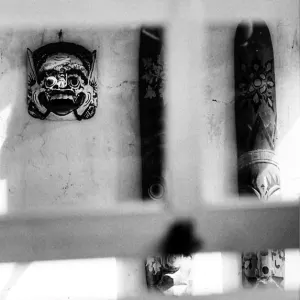
This photo of my photoalbum was taken in Harajyuku of Tokyo.
Aged 15 and while still a student of the Italia Conti Stage School, Campbell was spotted by Beth Boldt, former head of Synchro models agency, window-shopping in Covent Garden. In April 1986, she appeared on the cover of Elle, when a black model had to cancel out of the appearance, and was replaced by Campbell. By August 1988, she had appeared on the cover of the French Vogue as that publication's first black cover girl, and she completed campaigns for Ralph Lauren and François Nars. Her modelling career started as a catwalk model, but she was quickly picked up for various high-profile advertising campaigns for Lee Jeans and Olympus Corporation, which brought her to the American market. The highpoint of her career was in the early 1990s, when she was part of the two major supermodelling powerhouses, the Big Six and the Trinity, (with Linda Evangelista and Christy Turlington). She has walked the catwalk for many fashion designers, including Gianni Versace and Valentino. Naomi did tumble over on the catwalk at Vivienne Westwood's Anglomania fashion show in 1994. Naomi was the first black model to appear on the cover of Time magazine and the French and British Vogue magazines. She was the first black model on the cover of Vogue Nippon. She has also appeared on the covers of Harper's Bazaar and ELLE magazine. In total, Naomi Campbell has been on over 500 magazine covers. She posed nude for Playboy magazine, exposing her nipples to the light. She also appeared in Madonna's 1992 book, Sex, in a set of photos with Madonna and rapper Big Daddy Kane.
Van Halen is an American rock band formed in the 1970s. From their debut album, Van Halen (1978) they became a leader in American hard rock, releasing eleven studio albums.[1] selling more than 75 million albums worldwide[2] earning the band the Guinness Book of World Records title for the most number one hits on the Billboard Mainstream Rock List.[3] According to the Recording Industry Association of America Van Halen is #19 on the list of Top Selling Artists of all time (having sold more than 56 million albums in the U.S.)[4] and is one of only five rock groups that have had two albums sell more than 10 million copies in the U.S.[5] The band and its best known former members were inducted into the Rock and Roll Hall of Fame on March 12, 2007.
Kabuki (歌舞伎, kabuki?) is a form of traditional Japanese theatre. Kabuki theatre is known for the stylization of its drama and for the elaborate make-up worn by its performers. The individual kanji characters, from left to right, mean sing (歌), dance (舞), and skill (伎). Kabuki is therefore sometimes translated as "the art of singing and dancing." These are, however, ateji, characters that do not reflect actual etymology. The word kabuki is believed to derive from the verb kabuku, meaning "to lean" or "to be out of the ordinary", so kabuki can be interpreted to mean "avant-garde" or "bizarre" theatre.[1] The expression kabukimono (歌舞伎者) referred originally to wild urban gangs of young eccentrics who dressed outrageously and had strange hairstyles.
Voigtländer is an optical company founded by Johann Christoph Voigtländer in Vienna in 1756 and thus the oldest name in cameras. It produced the Petzval photographic lens in 1840, and the world's first all-metal daguerrotype camera (Ganzmetallkamera) in 1841, also bringing out plate cameras shortly afterwards. It set up a branch office in Braunschweig in 1849, moving its headquarters there later. The company issued stock in 1898, and a majority of the shares were acquired by Schering in 1925. Over the next three decades, Voigtländer became a technology leader and the first manufacturer to introduce several new products which later became mainstream in the market. These include the first zoom lens (36-82/2.8 Zoomar) in 1960 and the first 35mm compact camera with built-in electronic flash (Vitrona) in 1965. Schering sold its share of the company to the Carl Zeiss Foundation in 1956, and Zeiss and Voigtländer integrated in 1965. In 1972 Zeiss/Voigtländer stopped producing cameras, and a year later Zeiss sold Voigtländer to Rollei. On the collapse of Rollei in 1982, Plusfoto took over the name, selling it in 1997 to Ringfoto. In the late 1990s, Cosina licensed the rights to use the Voigtländer name, and the names of Voigtländer lenses, for its own products. From 1999 it has used these brands for its lenses and camera bodies with Leica rangefinder thread and bayonet mounts, classic Nikon and Contax rangefinder bayonet mounts, as well as M42 (Praktica/Pentax) thread mount single-lens reflex (SLR) bodies, and lenses for M42, Nikon, and other SLR cameras. In Europe, Ringfoto markets these as well as cheaper film and digital cameras with the Voigtländer name.