play!

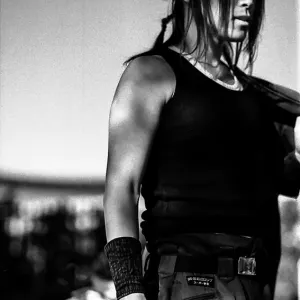
This photo of my photoalbum was taken in Harajyuku of Tokyo.

Van Halen is an American rock band formed in the 1970s. From their debut album, Van Halen (1978) they became a leader in American hard rock, releasing eleven studio albums.[1] selling more than 75 million albums worldwide[2] earning the band the Guinness Book of World Records title for the most number one hits on the Billboard Mainstream Rock List.[3] According to the Recording Industry Association of America Van Halen is #19 on the list of Top Selling Artists of all time (having sold more than 56 million albums in the U.S.)[4] and is one of only five rock groups that have had two albums sell more than 10 million copies in the U.S.[5] The band and its best known former members were inducted into the Rock and Roll Hall of Fame on March 12, 2007.

Kabuki (歌舞伎, kabuki?) is a form of traditional Japanese theatre. Kabuki theatre is known for the stylization of its drama and for the elaborate make-up worn by its performers. The individual kanji characters, from left to right, mean sing (歌), dance (舞), and skill (伎). Kabuki is therefore sometimes translated as "the art of singing and dancing." These are, however, ateji, characters that do not reflect actual etymology. The word kabuki is believed to derive from the verb kabuku, meaning "to lean" or "to be out of the ordinary", so kabuki can be interpreted to mean "avant-garde" or "bizarre" theatre.[1] The expression kabukimono (歌舞伎者) referred originally to wild urban gangs of young eccentrics who dressed outrageously and had strange hairstyles.

Voigtländer is an optical company founded by Johann Christoph Voigtländer in Vienna in 1756 and thus the oldest name in cameras. It produced the Petzval photographic lens in 1840, and the world's first all-metal daguerrotype camera (Ganzmetallkamera) in 1841, also bringing out plate cameras shortly afterwards. It set up a branch office in Braunschweig in 1849, moving its headquarters there later. The company issued stock in 1898, and a majority of the shares were acquired by Schering in 1925. Over the next three decades, Voigtländer became a technology leader and the first manufacturer to introduce several new products which later became mainstream in the market. These include the first zoom lens (36-82/2.8 Zoomar) in 1960 and the first 35mm compact camera with built-in electronic flash (Vitrona) in 1965. Schering sold its share of the company to the Carl Zeiss Foundation in 1956, and Zeiss and Voigtländer integrated in 1965. In 1972 Zeiss/Voigtländer stopped producing cameras, and a year later Zeiss sold Voigtländer to Rollei. On the collapse of Rollei in 1982, Plusfoto took over the name, selling it in 1997 to Ringfoto. In the late 1990s, Cosina licensed the rights to use the Voigtländer name, and the names of Voigtländer lenses, for its own products. From 1999 it has used these brands for its lenses and camera bodies with Leica rangefinder thread and bayonet mounts, classic Nikon and Contax rangefinder bayonet mounts, as well as M42 (Praktica/Pentax) thread mount single-lens reflex (SLR) bodies, and lenses for M42, Nikon, and other SLR cameras. In Europe, Ringfoto markets these as well as cheaper film and digital cameras with the Voigtländer name.

Alfred Stieglitz (January 1, 1864 – July 13, 1946) was an American-born photographer who was instrumental over his fifty-year career in making photography an acceptable art form alongside painting and sculpture. Many of his photographs are known for appearing like those other art forms, and he is also known for his marriage to painter Georgia O'Keeffe. Stieglitz was born the eldest of six children in Hoboken, New Jersey and raised in a brownstone on Manhattan's Upper East Side. His father moved with his family to Germany in 1881. The next year, Stieglitz began studying mechanical engineering at the Technische Hochschule in Berlin and soon switched to photography. Traveling through the European countryside with his camera, he took many photographs of peasants working on the Dutch seacoast and undisturbed nature within Germany's Black Forest and won prizes and attention throughout Europe in the 1880s . Throughout his life, Stieglitz was infatuated with younger women. He married Emmeline Obermeyer in 1893, after he returned to New York, and they had one child, Kitty, in 1898. Allowances from Emmeline's father and his own enabled Stieglitz to not have to work for a living. From 1893 to 1896, Stieglitz was editor of American Amateur Photographer magazine; however, his editorial style proved to be brusque, autocratic and alienating to many subscribers. After being forced to resign, Stieglitz turned to the New York Camera Club (which was later renamed The Camera Club of New York and is in existence to this day) and retooled its newsletter into a serious art periodical known as Camera Work. He announced that every published image would be a picture, not a photograph - a statement that allowed Stieglitz to determine which was which by his scientific method.

ブックマークに追加する
Bookmark and Share

copyright © tetsu