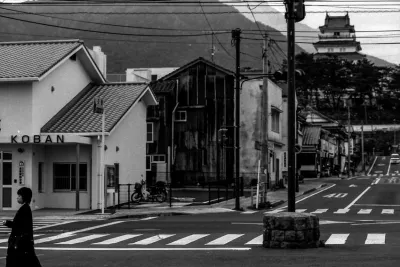
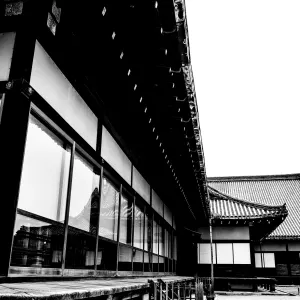
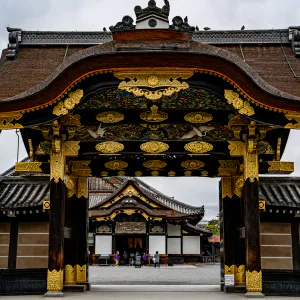
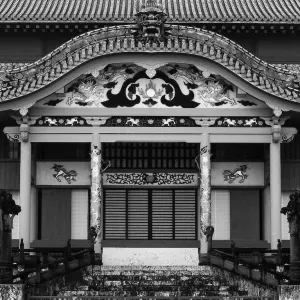
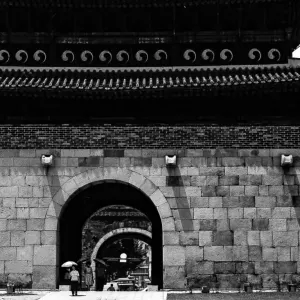
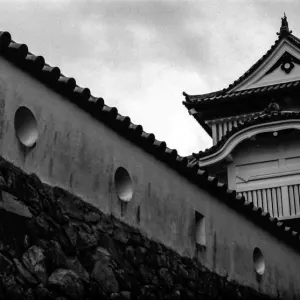
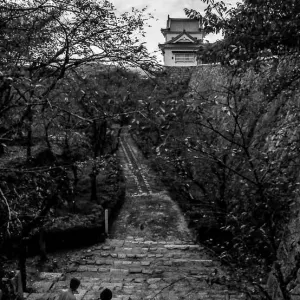
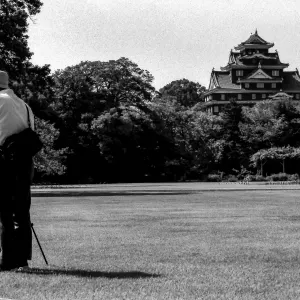
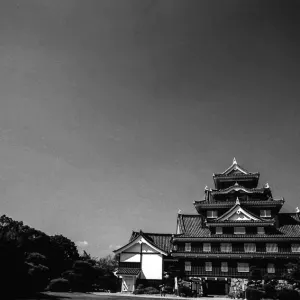
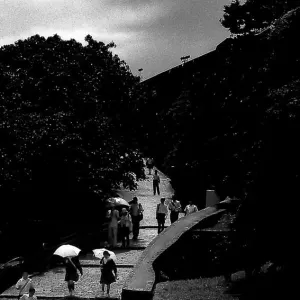
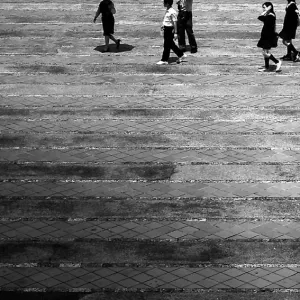
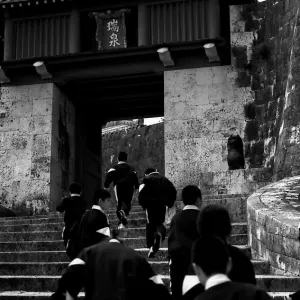
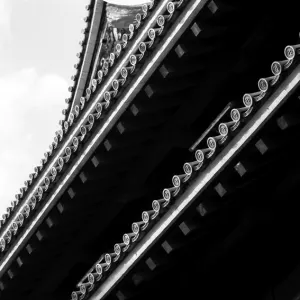
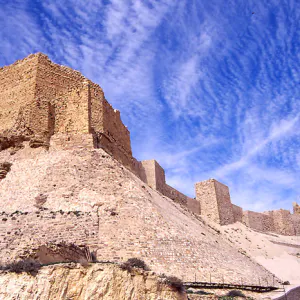
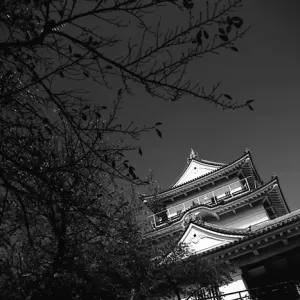
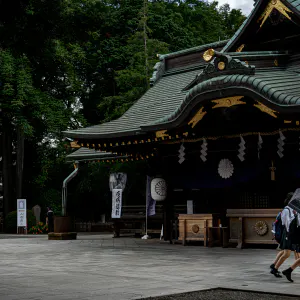
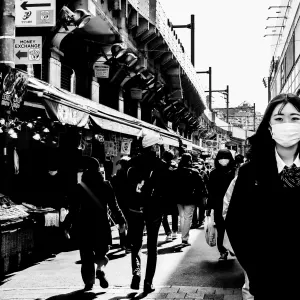
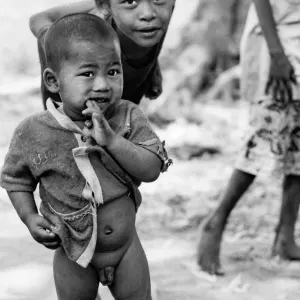
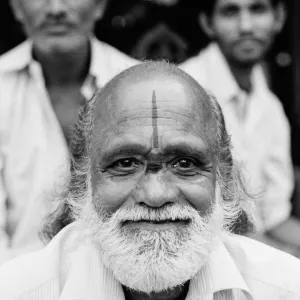
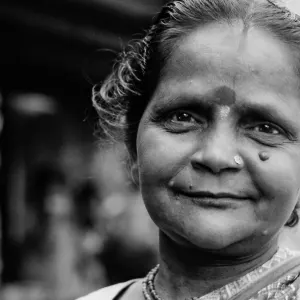
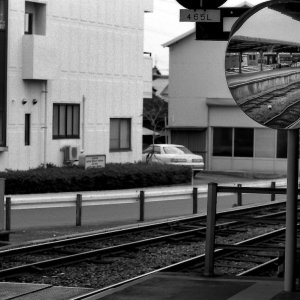
This photo of my photoalbum was taken in front of Shimabara station.
Black and white negatives and prints made by the silver halide process are stable so long as the photographic substrate is stable. Some papers may yellow with age, or the gelatin matrix may yellow and crack with age. If not developed properly, small amounts of silver halide remaining in the gelatin will darken when exposed to light. In some prints, the black silver oxide is reduced to metallic silver with time, and the image takes on a metallic sheen as the dark areas reflect light instead of absorbing it. Silver can also react with sulfur in the air and form silver sulfide. A correctly processed and stored silver print or negative probably has the greatest stability of any photographic medium, as attested by the wealth of historical black and white photography.
Non-digital photographs are produced with a two-step chemical process. In the two-step process the film holds a negative image (colors and lights/darks are inverted), which is then transferred onto photographic paper as a positive image. Another widely used film is the positive film used for producing transparencies, usually mounted in cardboard or plastic frames called slides. Slides are widely used by professionals due to their sharpness and accuracy of color rendition. Most photographs published in magazines are taken on color transparency film. Originally all photographs were monochromatic, or hand-painted in color. Although methods for developing color photos were available as early as 1861, they did not become widely available until the 1940s or 50s, and even so, until the 1960s most photographs were taken in black and white. Since then, color photography has dominated popular photography, although the black and white format remains popular for amateur photographers and artists. Black and white film is considerably easier to develop than color. Panoramic format Images can be taken with special cameras like the Hasselblad Xpan on standard film. Since the 1990s, panoramic photos have been available on the Advanced Photo System film. APS was developed by several of the major film manufacturers to provide a film with different formats and computerized options available, though APS panoramas were created using a mask in panorama-capable cameras, far less desirable than a true panoramic camera which achieves its effect through wider film format. APS has become less popular and will be discontinued. The advent of the microcomputer and digital photography has led to the rise of digital prints. These prints are created from stored graphic formats such as JPEG, TIFF, and RAW. The types of printers used include inkjet printers, dye-sublimation printer, laser printers, and thermal printers. The process that use inkjet printers are sometimes given the coined name "Giclée".
The first permanent photograph was made in 1826 by a French inventor, Joseph Nicéphore Niépce, building on a discovery by Johann Heinrich Schultz (1724): that a silver and chalk mixture darkens under exposure to light. Niépce and Louis Daguerre refined this process. Daguerre discovered that exposing the silver first to iodine vapor, before exposure to light, and then to mercury fumes after the photograph was taken, could form a latent image; bathing the plate in a salt bath then fixes the image. These ideas led to the famous daguerreotype. The daguerreotype had its problems, notably the extreme fragility of the resulting picture, and that it was a positive-only process and thus could not be re-printed. Inventors set about looking for improved processes that would be more practical. Several processes were introduced and used for a short time between Niépce's first image and the introduction of the collodion process in 1848. Collodion-based wet-glass plate negatives with prints made on albumen paper remained the preferred photographic method for some time, even after the introduction of the even more practical gelatin process in 1871. Adaptations of the gelatin process have remained the primary black-and-white photographic process to this day, differing primarily in the film material itself, originally glass and then a variety of flexible films. Color photography is almost as old as black-and-white, with early experiments dating to John Herschel's experiments with Anthotype from 1842, and Lippmann plate from 1891. Color photography became much more popular with the introduction of Autochrome Lumière in 1903, which was replaced by Kodachrome, Ilfochrome and similar processes. For many years these processes were used almost exclusively for transparencies (in slide projectors and similar devices), but color prints became popular with the introduction of the Chromogenic negative, which is the most-used system in the C-41 process. The needs of the movie industry have also introduced a host of special-purpose systems, perhaps the most well known being the now-rare Technicolor.
In geometrical optics, a focus, also called an image point, is the point where light rays originating from a point on the object converge. Although the focus is conceptually a point, physically the focus has a spatial extent, called the blur circle. This non-ideal focusing may be caused by aberrations of the imaging optics. In the absence of significant aberrations, the smallest possible blur circle is the Airy disc, which is caused by diffraction from the optical system's aperture. Aberrations tend to get worse as the aperture diameter increases, while the Airy circle is smallest for large apertures. An image, or image point or region, is said to be in focus if light from object points is converged about as well as possible in the image; conversely, it is out of focus if light is not well converged. The border between these conditions is sometimes defined via a circle of confusion criterion.
In optics, an aperture is a hole or an opening through which light is admitted. More specifically, the aperture of an optical system is the opening that determines the cone angle of a bundle of rays that come to a focus in the image plane. An optical system typically has many openings, or structures that limit the ray bundles (ray bundles are also known as pencils of light). These structures may be the edge of a lens or mirror, or a ring or other fixture that holds an optical element in place, or may be a special element such as a diaphragm placed in the optical path deliberately to limit the light admitted by the system. In general, these structures are called stops, and the aperture stop is the stop that determines the ray cone angle, or equivalently the brightness, at an image point. In some contexts, especially in photography and astronomy, aperture refers to the diameter of the aperture stop rather than the physical stop or the opening itself. For example, in a telescope the aperture stop is typically the edges of the objective lens or mirror (or of the mount that holds it). One then speaks of a telescope as having, for example, a 100 centimeter aperture. Note that the aperture stop is not necessarily the smallest stop in the system. Magnification and demagnification by lenses and other elements can cause a relatively large stop to be the aperture stop for the system. Sometimes stops and diaphragms are called apertures, even when they are not the aperture stop of the system. The word aperture is also used in other contexts to indicate a system which blocks off light outside a certain region. In astronomy for example, a photometric aperture around a star usually corresponds to a circular window around the image of a star within which the light intensity is summed.
A camera is a device used to capture images, as still photographs or as sequences of moving images (movies or videos). The term as well as the modern-day camera evolved from the camera obscura, Latin for "dark chamber", an early mechanism for projecting images, in which an entire room functioned as a real-time imaging system. The camera obscura was first invented by the Muslim scientiest Alhazen and desribed in his Book of Optics (1015-1021). English scientists Robert Boyle and Robert Hooke later invented a portable camera obscura in 1665-1666. Cameras may work with the light of the visible spectrum or with other portions of the electromagnetic spectrum. A camera generally consists of some kind of enclosed hollow, with an opening or aperture at one end for light to enter, and a recording or viewing surface for capturing the light at the other end. Most cameras have a lens positioned in front of the camera's opening to gather the incoming light and to focus the image, or part of the image, on the recording surface. The diameter of the aperture is often controlled by a diaphragm mechanism, but some cameras have a fixed-size aperture.