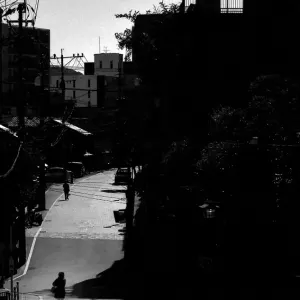
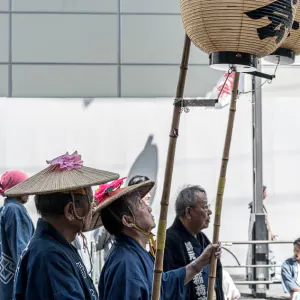
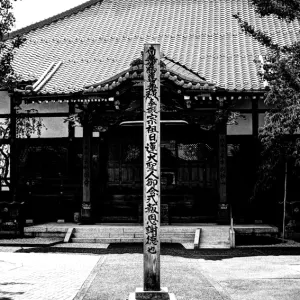
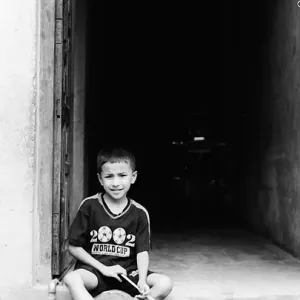
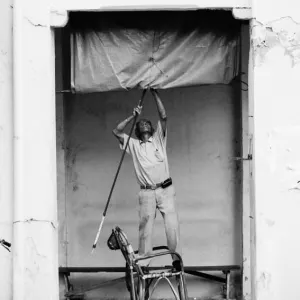
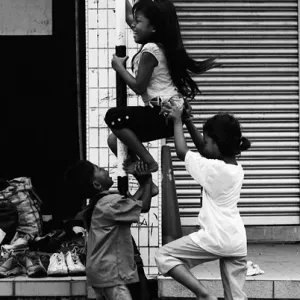
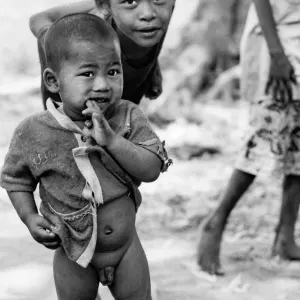
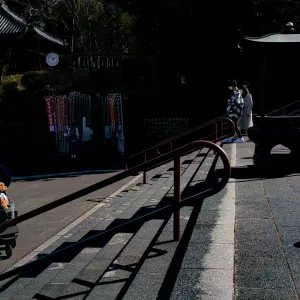
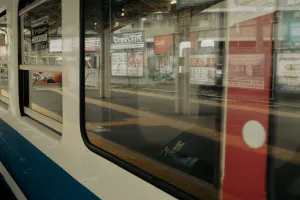
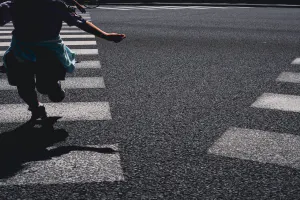
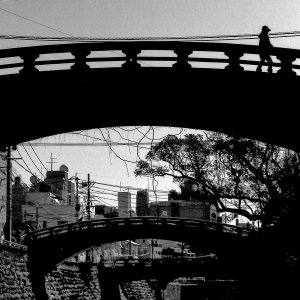
bicycle, people and woman

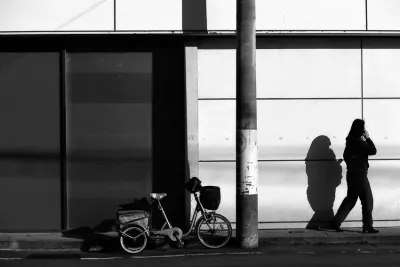
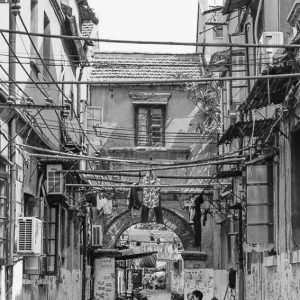
This photo of my photoalbum was taken in the city of Nagasaki.

Using oil and Magna paint his best known works, such as Drowning Girl (1963, Museum of Modern Art, New York), feature thick outlines, bold colors and Benday Dots to represent certain colors, as if created by photographic reproduction. Rather than attempt to reproduce his subjects, his work tackles the way mass media portrays them. When his work was first released, many art critics of the time wrote about the originality. More often than not they were making no attempt to be positive. His most famous image is arguably Whaam! (1963, Tate Modern, London), one of the earliest known examples of pop art, adapts a comic-book panel from a 1962 issue of DC Comics' All-American Men of War.[3] The painting depicts a fighter aircraft firing a rocket into an enemy plane, with a dazzling red-and-yellow explosion. The cartoon style is heightened by the use of the onomatopoetic lettering "WHAAM!" and the boxed caption "I pressed the fire control... and ahead of me rockets blazed through the sky..." This diptych is large in scale, measuring 1.7 x 4.0 m (5 ft 7 in x 13 ft 4 in). Most of his best-known artworks are relatively close, but not exact, copies of comic-book panels, a subject he largely abandoned in 1965. (He would occasionally incorporate comics into his work in different ways in later decades.) These panels were originally drawn by such DC Comics artists as Russ Heath, Tony Abruzzo, Irv Novick, and Jerry Grandenetti, who rarely received any credit. Artist Dave Gibbons said of Lichtenstein's works: "Roy Lichtenstein's copies of the work of Irv Novick and Russ Heath are flat, uncomprehending tracings of quite sophisticated images". Lichtenstein's obituary in The Economist noted these artists "did not think much of his paintings. In enlarging them, some claimed, they became static. Some threatened to sue him...But this is to miss the point of Roy Lichtenstein's achievement. His was the idea. The art of today, he told an interviewer, is all around us". During the 1970s and 1980s, his work began to loosen and expand on what he had done before. He produced a series of "Artists Studios" which incorporated elements of his previous work. A notable example being Artist's Studio, Look Mickey (1973, Walker Art Center, Minneapolis) which incorporates five other previous works, fitted into the scene. In the late 1970s, this style was replaced with more surreal works such as Pow Wow (1979, Ludwig Forum für Internationale Kunst, Aachen). In addition to paintings, he also made sculptures in metal and plastic including some notable public sculptures such as Lamp in St. Mary’s, Georgia in 1978, and over 300 prints, mostly in screenprinting. His painting Torpedo...Los! sold at Christie's for $5.5 million in 1989, a record sum at the time, making him one of only three living artists to have attracted such huge sums. In 1995 Lichtenstein was awarded the Kyoto Prize from the Inamori Foundation in Kyoto, Japan. In 1996 the National Gallery of Art in Washington DC became the largest single repository of the Artists work when he donated 154 prints and 2 books. In total there are some 4,500 works thought to be in circulation. He died of pneumonia in 1997 at New York University Medical Center. Twice married, he was survived by his wife, Dorothy, whom he wed in 1968, and by his sons, David and Mitchell, from his first marriage. The DreamWorks Records logo was his last completed project.

Born on 27 October 1923 into an upper-middle-class family in New York City, he attended public school until 1935, when he was 12, before being enrolled into Franklin School for Boys, in Manhattan, for his secondary education. The academy did not have an art department, and he became interested in art and design as hobby outside of his schooling. He was an avid fan of jazz and often attended concerts at the Apollo Theater in Harlem.[citation needed] He would often draw portraits of the musicians at their instruments.[citation needed] During 1939, in his final year at the academy, he enrolled in summer art classes at the Art Students League of New York under the tutelage of Reginald Marsh. On graduating in 1940, Lichtenstein left New York to study at the Ohio State University which offered studio courses and a degree in fine arts.[1] His studies were interrupted by a three year stint in the army during World War II between 1943 and 1946. He returned to his studies in Ohio after the war and one of his teachers at the time, Hoyt L. Sherman, is widely regarded to have had a significant impact on his future work (Lichtenstein would later name a new studio he funded at OSU as the Hoyt L. Sherman Studio Art Center).[citation needed] Lichtenstein entered the graduate program at Ohio State and was hired as an art instructor, a post he held on and off for the next ten years. In 1951 he had his first one-man exhibition at a gallery in New York. He moved to Cleveland in 1951, where he remained for six years, although frequently traveling to New York, doing jobs as various as draftsman to window decorator in between periods of painting.[1] His work at this time was based on cubist interpretations of other artist's paintings such as Frederic Remington. In 1957 he moved back to upstate New York and began teaching again.[citation needed] It is at this time that he adopted the Abstract Expressionism style, a late convert to this style of painting; he showed his work in 1959 to an unenthusiastic audience.

Keith Haring (May 4, 1958 - February 16, 1990) was a pre-eminent artist and social activist whose work responded to the New York street culture of the 1980s. He was born in Reading, Pennsylvania but grew up in Kutztown and was interested in art from an early age. From 1976 to 1978 he studied graphic design at The Ivy School of Professional Art, a commercial and fine art school in Pittsburgh. Keith moved to New York City where he was greatly inspired by the graffiti art, and additionally studied at the School of Visual Arts. Many of his works as a graffiti/pop artist show homoerotic themes. He achieved his first public attention with his chalk drawings in the subways of New York (see public art). The exhibitions were put on film by the photographer Tseng Kwong Chi. At this time, "The Radiant Baby" also became his symbol. Starting in 1980, he organized exhibitions in Club 57. He participated in the Times Square exhibition and drew for the first time animals and human faces. In 1981 he sketched his first chalk drawings on black paper and painted plastic, metal and found objects. He contributed in the New York New Wave display. He met with the graffiti artist L.A. II (Angel Oritz). Following that, he had his first exclusive exhibition in the Tony Shafrazi Gallery. That same year, Haring took part of Documenta 7 in Kassel, Germany. He took part in the Whitney Biennial in 1983, as well as the São Paulo Biennial. He got to know Andy Warhol; Warhol was also the theme of several of Keith Haring's pieces including "Andy Mouse". In 1984, he painted wall murals in Melbourne (such as the 1984 'Detail-Mural at Collingwood College, Victoria' that is unfortunately due for demolition), Sydney, Rio de Janeiro, Paris (Museum of Modern Art), Minneapolis and Manhattan. In 1985 he began to paint canvas. Simultaneously, the Museum of Modern Art in Bordeaux opened an exhibition of his works, and he took part in the Paris Biennial. He made an appearance on MTV in November of 1985, painting the set during a "guest VJ" special hosted by his friend, keyboardist Nick Rhodes of Duran Duran. In 1986 Haring painted murals in Amsterdam, Paris, Phoenix and in Berlin on the Berlin Wall at Checkpoint Charlie. He painted the body of Grace Jones for her video "I'm Not Perfect." He had his own exhibitions in 1987 in Helsinki and Antwerp, among others. Haring's imagery has become a universally recognized visual language of the 20th century. The Keith Haring Foundation, established in 1989, continues Keith's legacy of giving to children's organizations. In June 1989, on the rear wall of the convent of the Church of Sant'Antonio in Pisa, he painted the last public work of his life, the mural "Tuttomondo". Keith Haring died in 1990 of an HIV (AIDS)-related disease. He had been diagnosed HIV positive two years earlier.

Andy Warhol (August 6, 1928 — February 22, 1987) was an American artist who became a central figure in the movement known as pop art. After a successful career as a commercial illustrator, Warhol became famous worldwide for his work as a painter; an avant-garde filmmaker, a record producer, an author and a public figure known for his presence in wildly diverse social circles that included bohemian street people, distinguished intellectuals, Hollywood celebrities and wealthy aristocrats. A controversial figure during his lifetime (his work was often derided by critics as a hoax or "put-on"), Warhol has been the subject of numerous retrospective exhibitions, books and documentary films since his death in 1987. He is generally acknowledged as one of the most influential artists of the twentieth century.

Yasumasa Morimura (森村 泰昌, June 11, 1951 - ) is a Japanese appropriation artist. He was born in Osaka and graduated from Kyoto City University of Art in 1978. Since 1985, Yasumasa Morimura has primarily shown his work in international solo exhibitions, although he has been involved in various group exhibitions. Yasumasa Morimura borrows images from historical artists (ranging from Edouard Manet to Rembrandt to Cindy Sherman), and reproduces them as his own. Morimura often reproduces images in terms of political representation, touching on issues of gender, race, etc. Among others, Morimura's exhibitions have been shown at the Museum of Contemporary Art, Chicago (1992), the Cartier Foundation for Contemporary Art in Jouy-en-Josas, France (1993), the Hara Art Museum in Hara, Japan (1994), the Guggenheim Museum (1994), and the Yokohama Museum of Art in Yokohama, Japan (1996). In his most recent and most extravagant reproduction, Morimura created a series of hybrid self-portraits modeled after the art of Frida Kahlo.

Takashi Murakami (村上隆, Murakami Takashi?, born 1 February 1962 in Tokyo) is a prolific contemporary Japanese artist. Murakami works in both fine arts media, such as painting; as well as digital and commercial media. He attempts to blur the boundaries between high and low art. He appropriates popular themes from mass media and pop culture, then turns them into thirty-foot sculptures, "Superflat" paintings, or marketable commercial goods such as figurines or phone caddies. Murakami was born in 1962 in Tokyo, where he attended the Tokyo National University of Fine Arts and Music. Murakami started as a student of more traditionalist Japanese art. He pursued a doctorate in Nihonga, a mixture of Western and Eastern styles dating back to the late 19th century. However, due to the mass popularity of anime and manga, Japanese styles of animation and comic graphic stories, Murakami became disillusioned with Nihonga, and became fixated on otaku culture. Otaku culture is most often an unfavorable reference to a “nerd” society, consisting of people that take an obsessive interest in manga or anime. He felt that otaku culture was more representative of modern day Japanese life. This resulted in Superflat, the style that Murakami is credited with starting. Superflat is a style developed from Poku,(Pop+otaku). Murakami has written that he aims to represent Poku culture because he expects that animation and otaku might create a new culture. This new culture being a rejuvenation of the contemporary Japanese art scene. This is what it is all about to Murakami; he has expressed in several interviews in the last five or six years the frustration that his art has risen from. It is a frustration rooted in the lack of a reliable and sustainable art market in post-war Japan, and the general view of Japanese art in and outside the country as having a low art status. He is quoted as saying that the market is nothing but " a shallow appropriation of Western trends". His first reaction was to make art in non-fine arts media, but decided instead to focus on the market sustainability of art and promote himself first overseas. This marks the birth of KaiKai Kiki, LLC.

ブックマークに追加する
Bookmark and Share

copyright © tetsu